
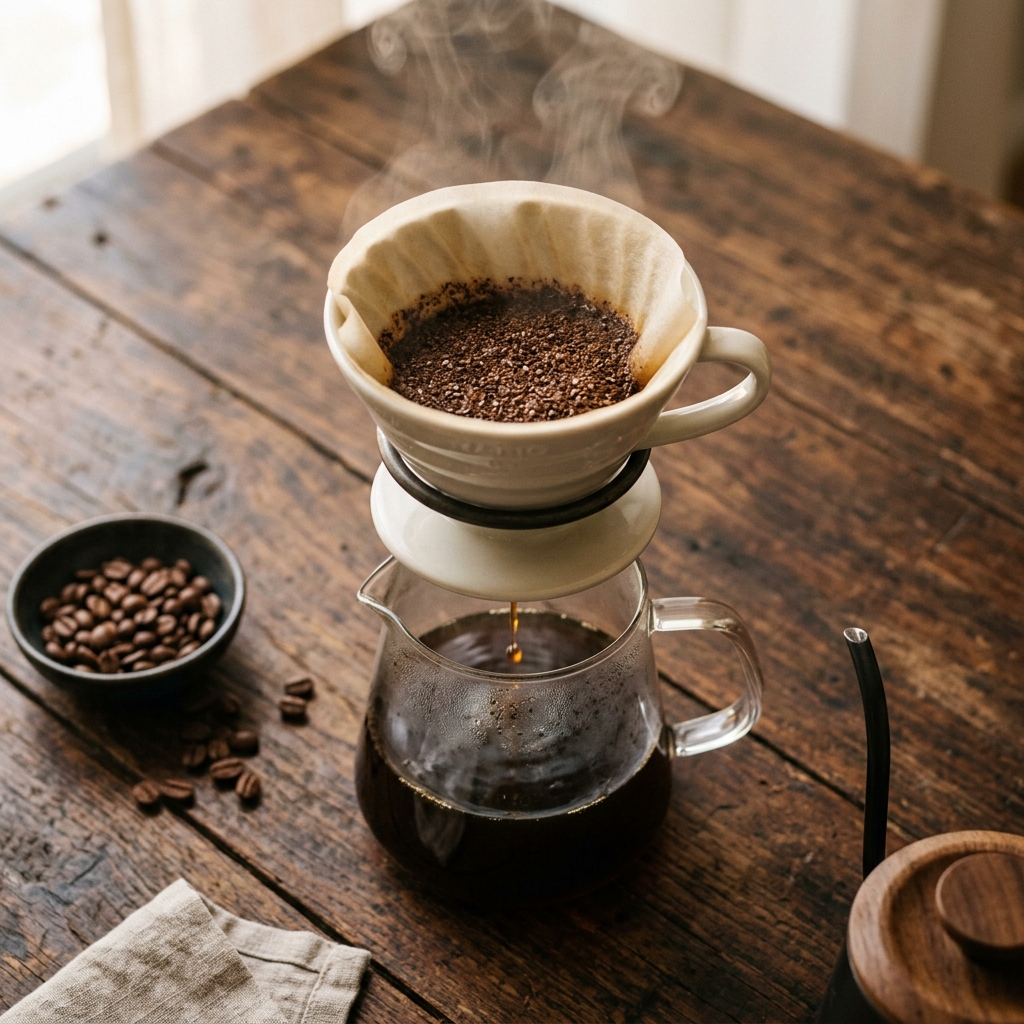
Pour-over coffee is often celebrated as the ultimate test of a barista's craft. Among all manual drippers, the Hario V60 stands as a legendary icon of specialty coffee. Its 60-degree cone angle, large single exit hole, and spiraling interior ribs allow for complete freedom over the brewing speed and contact time. But with great freedom comes the need for precision. To brew an exceptional cup, we must dive into the physical science of coffee extraction.
What is Coffee Extraction?
At its core, brewing coffee is the chemical process of dissolving soluble compounds from ground coffee beans into hot water. A roasted coffee bean is roughly 30% water-soluble. The remaining 70% consists of insoluble cellulose and fibers that form the bean's structure.
According to the Specialty Coffee Association (SCA), the ideal extraction yield—the percentage of the dry coffee weight that dissolves into the water—lies between 18% and 22%. Fall below 18%, and your cup is "under-extracted," tasting sour, salty, and thin. Exceed 22%, and it becomes "over-extracted," yielding bitter, dry, and hollow flavors.
The Golden Variables of V60 Brewing
To consistently navigate the narrow corridor of perfect extraction, you must master four primary variables:
1. Grind Size: The Surface Area Catalyst
Grinding coffee increases the surface area exposed to water. For a V60, aim for a medium-coarse consistency, similar to sea salt or coarse sand. If the grind is too fine, the water drains too slowly, leading to channel bypass and bitterness. If it's too coarse, water rushes through without dissolving the sweet organic acids and sugars, resulting in a sour under-extracted cup.
2. Water Temperature: The Thermal Solvent
Water acts as a solvent, and its temperature dictates how rapidly compounds dissolve. Light-roasted specialty coffees (which have denser cell structures) require higher temperatures, ideally between 92°C and 96°C (198°F to 205°F), to unlock complex floral and fruit notes. Darker roasts, being more soluble and fragile, benefit from cooler water (88°C to 90°C) to avoid pulling harsh, heavy carbon notes.
3. The Pour Technique: Turbulence and Agitation
How you pour water into the V60 creates turbulence, which physically agitates the coffee bed and speeds up extraction. A steady, gentle spiral starting from the center outward ensures even wetting. Avoid pouring directly onto the paper filter, as this causes water to bypass the coffee bed entirely and dilute your brew.
Step-by-Step V60 Golden Method
Ready to brew? Use our recommended 1:16 ratio (15g of coffee to 240g of water):
- Step 1: Rinse and Preheat. Place your paper filter in the V65 and rinse it thoroughly with boiling water. This removes any woody, paper-like taste and warms your ceramic/glass brewer. Discard the rinse water.
- Step 2: The Bloom (0:00 - 0:45). Add 15g of freshly ground coffee. Start your timer and pour 45g of water (three times the coffee weight). Give the brewer a gentle swirl to ensure all grounds are fully wet. The "bloom" allows trapped carbon dioxide gas to escape, paving the way for smooth extraction.
- Step 3: The Main Pour (0:45 - 1:30). Gently pour in circular spirals up to 150g. The stream should be thin and consistent. Let the water level draw down slightly.
- Step 4: The Final Stretch (1:30 - 2:00). Pour in a focused center stream up to 240g. Give the dripper one final, gentle swirl to flatten the coffee bed as it drains.
- Step 5: The Drawdown (2:00 - 3:00). The water should completely drain through by the 3-minute mark, leaving a perfectly flat, clean bed of coffee grounds.
Pouring a great V60 is a meditative ritual. By dialing in your variables and tracking your sensory outcomes in the Vidita Cafe Journal, you will turn a morning routine into an evolving sensory art form.