
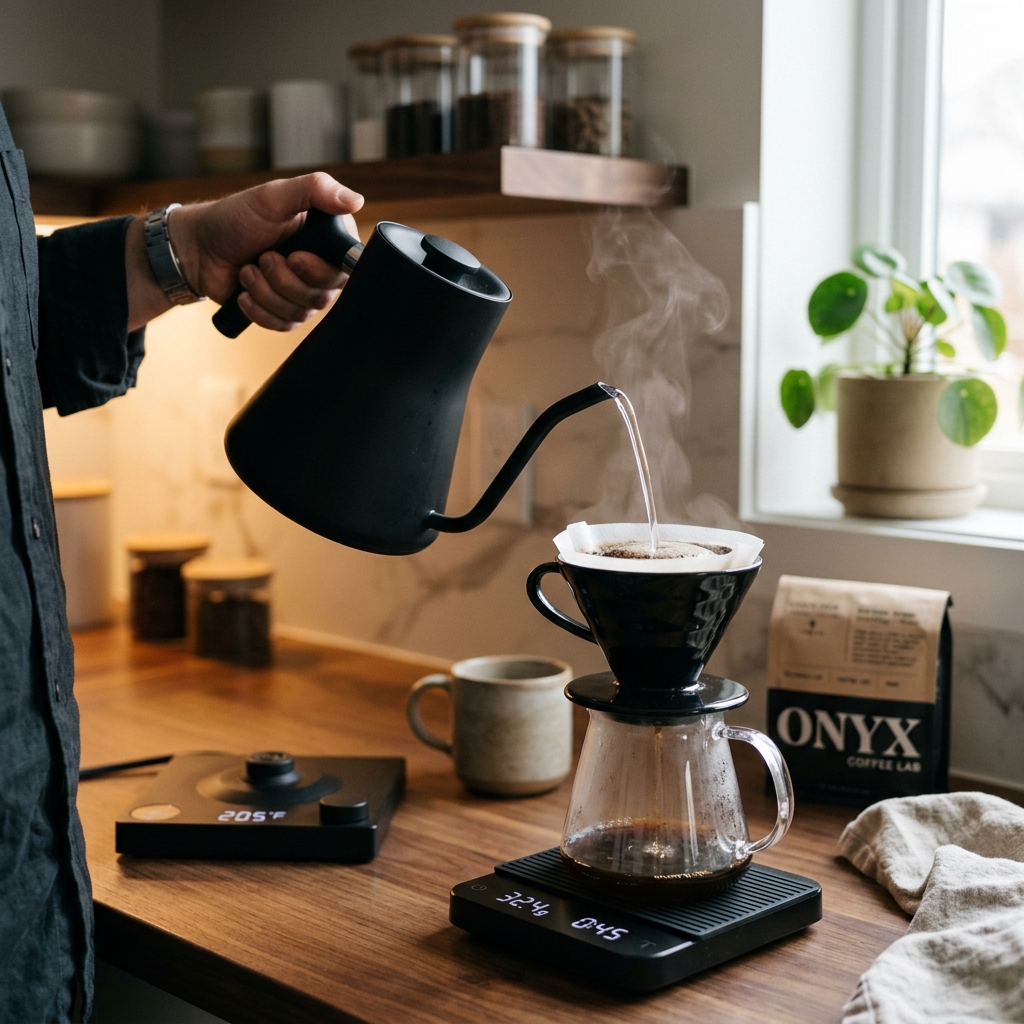
If you're stepping into the world of specialty filter coffee, you will quickly notice a peculiar tool gracing every barista's counter: the gooseneck kettle. With its slender, curved spout and elegant styling, it looks more like a tea ceremony relic than high-tech coffee gear. But make no mistake: this is a highly engineered precision instrument.
Is a specialized gooseneck kettle—especially one with electronic temperature control—really necessary, or is it just aesthetic hype? Let's break down why this single piece of equipment has revolutionized manual coffee brewing.
1. The Art of Flow Rate Control
In manual pour-over methods (like the V60, Chemex, or Kalita Wave), you are the pump. How fast and where you pour water directly determines the extraction rate and contact time. A standard kettle dumps water in a thick, turbulent rush, violently agitating the coffee bed, pushing grounds up the filter walls, and creating channels of bypass where water slips through unextracted.
A gooseneck kettle's curved spout restricts water flow, allowing you to pour a thin, vertical stream with near-zero effort. You gain absolute precision over your brew footprint, enabling you to agitate the coffee bed perfectly and maintain a flat, even coffee bed for consistent extraction from the first drop to the last.
2. Thermal Stability & Temperature Control
Water is the universal solvent in coffee extraction, and heat is the energy that drives the dissolution of organic acids, oils, and sugars. Different chemical compounds dissolve at different temperatures:
- High Solubles (Acids & Fruity Aromas): Dissolve first and most rapidly, requiring high thermal energy (92°C to 96°C).
- Medium Solubles (Sugars & Caramel): Dissolve next, adding sweetness and balance.
- Low Solubles (Bitter, Carbon, & Heavy compounds): Dissolve last, especially under excessive heat (97°C+).
A temperature-controlled electric kettle allows you to set your target temperature down to the exact degree and hold it there. This eliminates the guesswork of boiling water on a stove and waiting. More importantly, it ensures that your bloom, first pour, and final pour are done with highly consistent thermal stability, eliminating erratic extraction variations.
Which Kettle Fits Your Workflow?
When selecting a gooseneck kettle, consider three primary attributes:
Stovetop vs. Electric
Stovetop kettles are highly durable, budget-friendly, and great for travel, but they require an external heat source and a separate thermometer to read temperatures. Electric models are self-heating, faster, and typically feature built-in PID controllers that keep water heated to your target temperature for up to an hour.
Flow Restriction
Some kettles (like the Fellow Stagg EKG) feature heavily restricted spouts designed for slow, ultra-precise vertical streams, perfect for V60 pour-overs. Others (like the Hario Buono) offer a wider spout profile, giving you a faster flow rate range that is highly versatile for French press, Chemex, and tea.
Ergonomics & Balance
A good kettle should feel like an extension of your arm. Look for counterbalanced handles where the center of mass is shifted back toward your hand, reducing wrist fatigue as you hold a steady pour for three minutes.
The Bottom Line
Can you brew coffee without a gooseneck kettle? Absolutely. But if you want to consistently unlock the bright floral notes of an Ethiopian Geisha or the juicy peach profile of a washed Colombian, temperature stability and flow precision are non-negotiable.
Track your equipment setups and catalog your gear inside the Vidita Cafe Coffee Bar. By keeping detailed logs of your water temperatures and gear configurations, you will unlock the hidden potential of your favorite roasts.